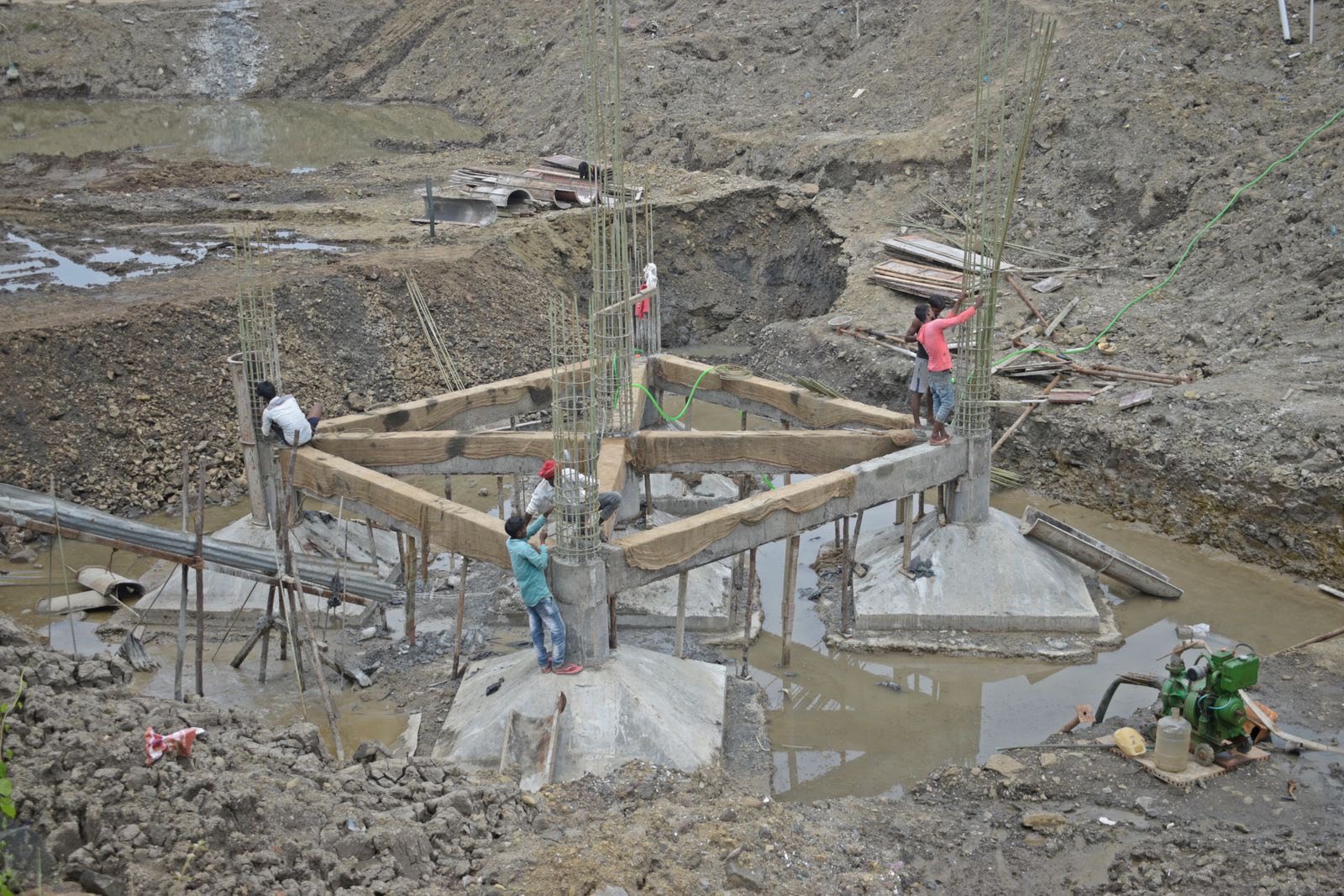
Columns carry the entire load of the house down to the footings, and they are cast one floor at a time with no second chances. Where the lap goes, why rings sit closer near the joints, and how to avoid honeycombing - with the code numbers that govern each.
Columns are the pillars of the house - they carry the entire load from the roof down to the footings. A column is also unforgiving: once cast, its steel, cover and position are fixed. If the column goes crooked, the whole floor above it goes crooked, so plumb and cover both have to be right before the concrete goes in.
Two placement rules do most of the work. First, keep the rings (lateral ties) close together - 100 mm or less - just above and below the beam-column joint, because that zone takes the most stress in an earthquake (IS 13920:2016). Second, keep the steel lap joint in the middle half of the column's height, never near the slab or beam, for the same reason.
Two mistakes that cannot be fixed later
- Honeycombing: hollow spots in the concrete where no vibrator was used or concrete was dropped from a height, so the aggregate separated. The fix is prevention - pour in layers of about 500 mm and run a needle vibrator on each layer.
- Steel touching the shuttering: cover becomes zero, and after casting the bars show on the surface and rust. Tie round cover blocks on all four faces roughly every metre so the cage stays centred (IS 456, 26.4.2.1).
The right sequence, in six steps
- Mark the centre line and all four edges of each column from the grid lines.
- Erect the cage on the starter bars; lap length exactly as per the drawing.
- Tie 40 mm cover blocks on all four faces, about every metre.
- Fix the shuttering, check plumb from two directions, brace with props.
- Cast in ~500 mm layers with a vibrator on each layer; never drop concrete from a height.
- Open the shuttering after 16-24 hours and cure with wet gunny bags.
Numbers worth remembering
- Minimum main bars in a rectangular column: 4 bars of at least 12 mm (IS 456, 26.5.3.1)
- Cover on column steel: 40 mm (IS 456, 26.4.2.1)
- Ring spacing in general: not more than the least column width, 16 bar diameters, or 300 mm (IS 456, 26.5.3.2)
- Rings near the joint: 100 mm or closer (IS 13920:2016)
- Shuttering removal: 16-24 hours (IS 456, Table 11)
Site checklist before casting
- Centre line matched to the grid; number and diameter of bars as per drawing
- Lap in the middle portion, correct length; rings with 135-degree hooks, closer near joints
- 40 mm cover blocks on all sides; shuttering plumb from two directions
- A working vibrator actually on site
This guide is adapted from BHK99's illustrated site handbook series. The columns hold everything else up - read next how beams carry the slab load into them, or see what a full structure costs with our construction cost calculator.